Fostering Innovation Through Our Seed and Scaling Grant Programs
MnBA’s Seed Grant Program is a catalyst for industry engagement with University of Minnesota biotechnology innovations. It enables researchers to advance market and milestone driven projects, build interdisciplinary teams, and generate the data and testable prototype needed to pursue larger state, federal, or industry investment.
Future funding will focus on scaling technologies through a Scaling Grant, leveraging University of Minnesota's expertise and infrastructure to continue advancing technologies toward commercial readiness.
Overview
Launched in 2024, MnBA's seed grants focused on early translation of biotechnology breakthroughs into practical, scalable applications to strengthen Minnesota’s bioeconomy, support workforce growth, and create lasting environmental and economic impact.
Objectives

Foster Innovation
MnBA’s Seed Grant Program encourages bold, creative approaches to some of Minnesota’s most pressing bioeconomic challenges.

Enable Cross-Disciplinary Work
Innovation happens where disciplines meet. Teams have brought together experts from external organizations, 4 colleges and 1 institute across the University of Minnesota biotechnology ecosystem

Support Early-Stage and Scalable Research
Seed and scale funding enables University of Minnesota researchers to advance novel biotechnologies, generate pilot data, and build proof-of-concept prototypes.

Generate Extramural Funding
The program is designed to build momentum toward larger external investments from government, foundations, and industry targeting commercialization and economic development.

Strengthen Partnerships
Seed grants connect university research with public- and private-sector collaborators to bring market solutions.

Engagement with State businesses
Research teams collaborate and align research investments with state policy objectives and industry needs, ensuring that discoveries translate into tangible benefits for Minnesota’s communities, industries, and workforce.
MnBA Seed Grants
Awardees (2025)

Microbial Electrochemical Factories for Green Ammonia Synthesis (Phase II)
PI: Daniel Bond (CBS)
This project is an extension of a 2024 seed grant project and pioneers a novel, bio-electrochemical method for ammonia synthesis. As Minnesota’s industries increasingly adopt electrolyzer-produced hydrogen, this project offers a compatible and innovative biological solution for ammonia production.
The core of the technology replaces the conventional energy-intensive Haber-Bosch process with an energy efficient system using nitrogen-fixing bacteria. These unique microorganisms can convert atmospheric nitrogen directly into ammonia by using electrodes as an energy source. The project focuses on two key areas of technological advancement: genetically modifying these bacteria to maximize ammonia output and engineering advanced reactors to improve the efficiency of large-scale implementation. By integrating biology with electrochemistry, this project is developing a new pathway for localized, on-demand ammonia production to serve the agricultural and transportation fuel sectors.
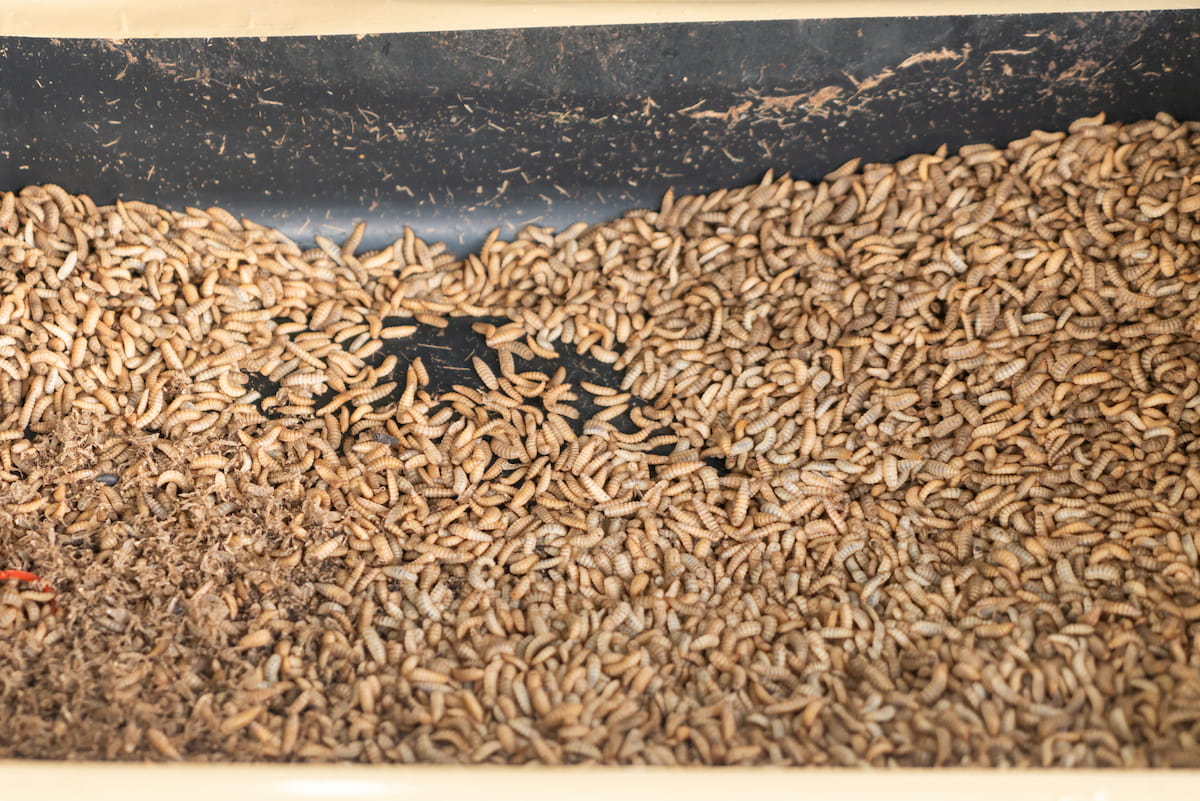
Pilot-Scale Rearing and Down-Stream Processing of Engineered Insect Oil Factories (Phase II)
PI: Michael Smanski (CBS)
This research builds on the successful genetic engineering of black soldier flies (BSF) to produce a high-value oil for animal feed, a breakthrough that overcomes previous economic limitations in BSF agriculture. As an extension of a 2024 seed grant, the team is now focused on de-risking the commercialization of this technology at a pilot scale.
The project approach involves two key technological advancements. The team will develop an innovative, low-cost feedstock by upcycling common carp, an invasive species in Minnesota that is often discarded in landfills. This BSF rearing system transforms a waste stream into a valuable resource for the scaled production of our engineered, oil-rich BSF larvae. Also, the team will optimize the downstream processing of the BSF larvae to enable optimized production towards an economically viable cost.
This project represents the critical mid-scale technology development necessary to move a promising biotechnology product from the lab toward commercial scale.

Wood Waste to Walls: Pioneering a Regional Bioeconomy of Biochar-Based Carbon-Sequestering Building Materials (Phase II)
PI: Malini Srivastava (CDes)
This project is an extension of a 2024 seed grant and pioneers the development of novel, sustainable building materials by upcycling regional waste streams. At the core of this innovation is biochar, a versatile material created from thermally-decomposed biomass. The team will manufacture prototypes of biochar-containing bricks and plaster for a wide range of applications in buildings, landscapes, and urban infrastructure. Beyond its use as a building material, biochar also shows promise for absorbing pollutants and as a growth medium for plants.
A key objective is to establish the feasibility of a regional manufacturing ecosystem for these innovative materials. By sourcing from waste biomass and urban, diseased trees, this project supports forest health and creates a new bio-economy in Minnesota. This regional ecosystem would create a sustainable approach to upcycling waste and developing in-demand building materials.